Modern product-led organizations with a strong product culture will typically apply what has come to be known as dual-track Agile, each track with a specific purpose:
Jeff Patton
All organizations, not restricted to the product-led ones, want to be effective and efficient. How they do it depends on their context and business model. For the modern high-tech product organization, the dual-track Agile approach has become one of the Good Practices (hard to claim any practices to be “best”).
We’re running Scrum and have people equipped with all sorts of Agile certifications, therefore we’re super good at Product Discovery! In fact, we’ve engaged a number of Agile Coaches to do even better!
You might actually be super good at Product Discovery, but it is not due to Scrum (or e.g., Kanban for that matter) and probably not due to your Agile Coaches as expressed by Marty Cagan:
Discovery coaches are typically former product managers or product designers and they have usually worked for leading product companies. So they are able to work side by side with actual product managers and designers – not just reciting Agile platitudes, but showing the team how to work efficiently.
It is hard for me to imagine an effective discovery coach who doesn’t have first-hand experience as a product manager or product designer at a modern product company.
Marty Cagan, INSPIRED p. 289-290
Melissa Perri follows suit, pointing-out that the adaption of Agile is not the same as getting great at product management:
Agile assumed that someone was doing that front-of-funnel part, generating and validating ideas, and instead optimized the production of software. Yet, that piece has been lost along the way, as companies believe that Agile is all you need to do successful software development. So, many product managers in Agile organizations still operate with this Waterfall mindset.
Melissa Perri, Escaping the BUILD TRAP p. 26
Teresa Torres starts her book, Continuous Discovery Habits with the same point:
… many companies put a heavy emphasis on delivery – they focus on whether you shipped what you said you would on time and on budget – while under-investing in discovery, forgetting to asses if you built the right stuff.
Teresa Torres, Continuous Discovery Habits p. 13-14
A lot has been and is being written about the Development / Delivery track. This post will take a swim in the pool of Product Discovery Techniques.
Marty Cagan sums-up the purpose of Product Discovery:
…
Much of the key to effective product discovery is getting across to our customers without trying to push our quick experiments into production.
… If you want to *discover* great products, it really is essential that you get your ideas in front of real users and customers early and often.
If you want to *deliver* great products, you want to use the best practices for engineering and try not to override the engineers’ concerns.
Marty Cagan, INSPIRED p. 163
If you haven’t already done it, I suggest reading the previous article From Vision to Delivery and Outcome in the product-led organization giving you a framework of reference before moving on.
The primary inspirational sources for this post
You’ll find a growing number of books and even more on-line articles on the topic of Product Discovery. In this post I’ll primarily seek inspiration in the following books:
The Product Manager
Before jumping into the pool of Product Discovery techniques, lets take a step back understanding the realm of Product Management:
At the heart of it we’re finding exactly the Product Discovery discipline being where the modern Product Manager will spend a significant amount of time. Marty Cagan has repeatedly made it clear, that the Scrum Product Owner role is only a fraction of much larger role as Product Manager. Melissa Perri agrees:
When you look at the role of the product owner in most Scrum literature, the three responsibilities of the position include the following:
- Define the product backlog and create actionable user stories for the development teams
- Groom and prioritize the work in the backlog
- Accept the completed user stories to make sure the work fulfills the criteria
… it leaves lots of questions unanswered and these questions are important for creating successful products:
- How do we determine value?
- How do we measure the success of our products in the market?
- How do we make sure we are building the right thing?
- How do we price and packet our product?
- How do we bring our product to market?
- What makes sense to build vs buy?
- How can we integrate with third-party software to enter new markets?
Product ownership is just a piece of product management.
… product owner is a *role* you play on a Scrum team. Product manager is a *career*
If you take your Scrum team away, and Scrum as a process, you are still a product manager. Product management and Scrum can work well together, but product management is not dependent on Scrum. This role should exist with any framework or process …
Melissa Perri, Escaping the BUILD TRAP p. 37
Product Discovery principles
In chapter 33 of INSPIRED, Marty Cagan recommends following a set of core discovery principles:
- It’s our job to make sure the solution we deliver solves the underlying problem. This is probably the most fundamental principle in all modern product.
- The hardest part of all is creating the necessary value. This is generally where we’ll need to spend most of our discovery time.
- As hard and important as engineering is, coming up with a good user experience is usually even harder, and more critical to success.
- Today, we know that the technology drives (and enables) the functionality as much as the other way around. We know that technology drives (and enables) design. We know that design drives (and enables) functionality. The point is that all three of these are completely intertwined. This is the single biggest reason we push so hard for the product manager, product designer, and the tech lead to sit physically adjacent to each other.
- The most important thing is to know what you can’t know (which is exactly what Melissa Perri points to above).
- We must validate our ideas on real users and customers. We need to do this before we spend the time and expense to build an actual product, and not after.
- Our goal in discovery is to validate our ideas the fastest, cheapest way possible. Discovery is about the need for speed.
- We need to validate the feasibility of our ideas during discovery, not after (see later – can we build it?)
- We need to validate the business viability of our ideas during discovery, not after.
- It’s about shared learning. One of the keys to having a team of missionaries rather than a team of mercenaries is that the team has learned together.
In their book Product Discovery: A no-nonsense guide to building effective products and services, Marcus Castenfors and Martin Christensen provide us with their set of guiding principles (structured in the same way as the original Agile Manifesto).
These principles are fully in line with and support the other authors.
The British Design Council’s framework for innovation – also known as the Double Diamond model – applies the same principle as the Dual-track Agile model: Separate focus on Problem and Solution. In this illustration of the Double Diamond model, the iterative part has been made explicit:
Some teams are able to switch context between the problem and solution spaces within the same sprint. Other teams prefer “clean” problem or solution sprints.
The toolbox of Product Discovery techniques
Let’s start with a disclaimer: the breadth and depth of Product Discovery techniques is not only huge – it is constantly evolving making it impossible to provide a full map of all current techniques in all types of industries and business models.
Here I’ll try to provide an overview of the commonly used techniques – most of which found in my inspirational sources.
The majority of literature on the subject circles around purely digital products. The thinking is however fully valid and relevant for multidisciplinary products, the point being that we recognize and respect the constraints imposed by the physical world (electronics, mechanics, environmental, logistics, production, supply-chain, health & safety, regulations, norms, standards, certifications …).
For (purely) digital products, Marty Cagan brings focus to four essential product risks. Here with a fifth risk-area added, related to the production and lifecycle of physical products:
- valuable for the customer
- usable for the customer as intended
- feasible for us to build
- viable for our business
- feasible for us to produce and deliver the product (in serial production)
Through disciplined Product Discovery we want and need to gain insights and control over these five product risk areas, before investing heavily in the Development / Delivery of an actual product!
Now – let’s open the toolbox of Product Discovery techniques.
INSPIRED PART IV THE RIGHT PROCESS page 159-307
Marty Cagan has dedicated a significant part of INSPIRED to Product Discovery Techniques. I highly recommend reading the whole book. Here I’ll just scratch the surface.
DISCOVERY FRAMING TECHNIQUES
- Opportunity Assessment Technique
- Customer Letter Technique
- Startup Canvas Technique
DISCOVERY PLANNING TECHNIQUES
- Story Map Technique
- Customer Discovery Program Technique
DISCOVERY IDEATION TECHNIQUES
- Customer Interviews
- Concierge Test Technique
- The Power of Customer Misbehavior
- Hack Days
DISCOVERY PROTOTYPING TECHNIQUES
- Feasibility Prototype Technique
- User Prototype Technique
- Live-Data Prototype Technique
- Hybrid Prototype Technique
You might be wondering – what happened to Eric Ries’ classic The Lean Startup in the list of inspirational sources?
I’ve found it misleading when it comes to the notion of MVPs. Just to strengthen my point, here is a quote from Marty Cagan:
… while the P in MVP stands for *product*, an MVP should *never* be an actual product (where product is defined as something your developers can release with confidence, that your customers can run their business on, and that you can sell and support).
The MVP should be a *prototype*, not a product.
…
I find that using the more general term *prototype* makes this critical point clear to the product team, the company, and the prospective customers.
… in this book I talk about different types of *prototypes* being used in discovery and *products* being produced in delivery.
Marty Cagan, INSPIRED p. 29-30
DISCOVERY TESTING TECHNIQUES
- Testing Usability
- Testing Value
- Demand Testing Technique
- Qualitative Value Testing Techniques
- Quantitative Value Testing Techniques
- Testing Feasibility
- Testing Business Viability
TRANSFORMATION TECHNIQUES
- Discovery Sprint Technique
- Pilot Team Technique
Teresa Torres in Continuous Discovery Habits
First of all – if you’ve not yet read Teresa’s book, I highly recommend doing so. It is impossible to give full credit to this important book here. I’ll just convey a couple of high-lights.
The Opportunity Solution Tree [OST]
The root of the tree is your desired outcome – the business need that reflects how your team can create business value.
Next is the opportunity space. These are the customer needs, pain points, and desires that, if addressed, will drive your desired outcome.
Below the opportunity space is the solution space. This is where we’ll visually depict the solutions we’re exploring.
Below the solution space are assumption tests. This is how we’ll evaluate which solutions will help us best create customer value in a way that drives business value.
Teresa Torres, Continuous Discovery Habits p. 30
You might recall the mapping from product strategy over product discovery to product delivery in the earlier post.
Below is an attempt to merge Teresa Torres’ Opportunity Solution Tree with the strategy-discovery-delivery map:
- Resolve the tension between business needs and customer needs
- Build and maintain a shared understanding of how they might reach their desired outcome
- Adopt a continuous mindset
- Unlock better decision-making
- Unlock faster learning cycles
- Build confidence in knowing what to do next
- Unlock simpler stakeholder management
Teresa Torres, Continuous Discovery Habits p. 30
To get the full story on how to leverage the use of the Opportunity Solution Tree, go read Teresa’s book.
Wrap-up
Yes – (continuous) Product Discovery is definitely a deep rabbit hole in its own right. The good news is that you’ll find a lot of helpful material out there to guide you.
Happy Discovery!

For each OKR cycle the individual (product) team faces the challenge to meet the agreed OKRs by planning and executing the right work in the six sprints within the OKR cycle.
The product trio supported by the delivery manager must be able dynamically to shift focus between the OKR level and the very specific now and here Sprint Backlog activities.
As concluded
You can chose the seemingly easy route and adapt an already-made cookbook prescription forcing a framework over your organization. This is what has happened in a significant number of companies going all-in with

Classically an organization would do development in one branch, “throwing the result over the fence” to another branch doing operations.
A more modern approach is known as DevOps (a contraction of Development and Operations) having a team own the whole ting. The principle is “you build it – you run it”.
Virtualization (like virtual machines and container technologies) and Cloud technologies have improved that a lot with e.g., modelling infrastructure in configuration files. This is call Infrastructure as Code [IaC] (using e.g., YAML files). The infrastructure code is under version control and integrated in the full configuration.
5+ years ago a new computing paradigm saw the light of day, and was coined the Cloud Serverless Architecture. Not that there are no servers, but that the operations complexities became fully encapsulated. All the major Clouds providers (Amazon – AWS, Microsoft – Azure and Google – Google Cloud) have and mature Serverless services.
Two examples of an IDP are
Today [November 2021] Backstage has gained momentum having 
These objectives are given by the context. Before even starting the discussion on the means, the context and thus the objectives need to be understood. As mentioner earlier e.g.,
The Agile community wanted (my interpretation) clearly and strongly to divorce itself from the classic way of doing (software) projects. The project manager role represented the “old way of working” to an extend that it was not welcome in the Agile role definitions – not even as a variant.
An IT Project is a type of project with “just” one technology discipline – IT (in itself having a ton of different disciplines) – in contrast to
The purpose for all projects including IT Projects is, logically speaking, to convert customer/user problems/desires to solutions meeting these problems/desires.
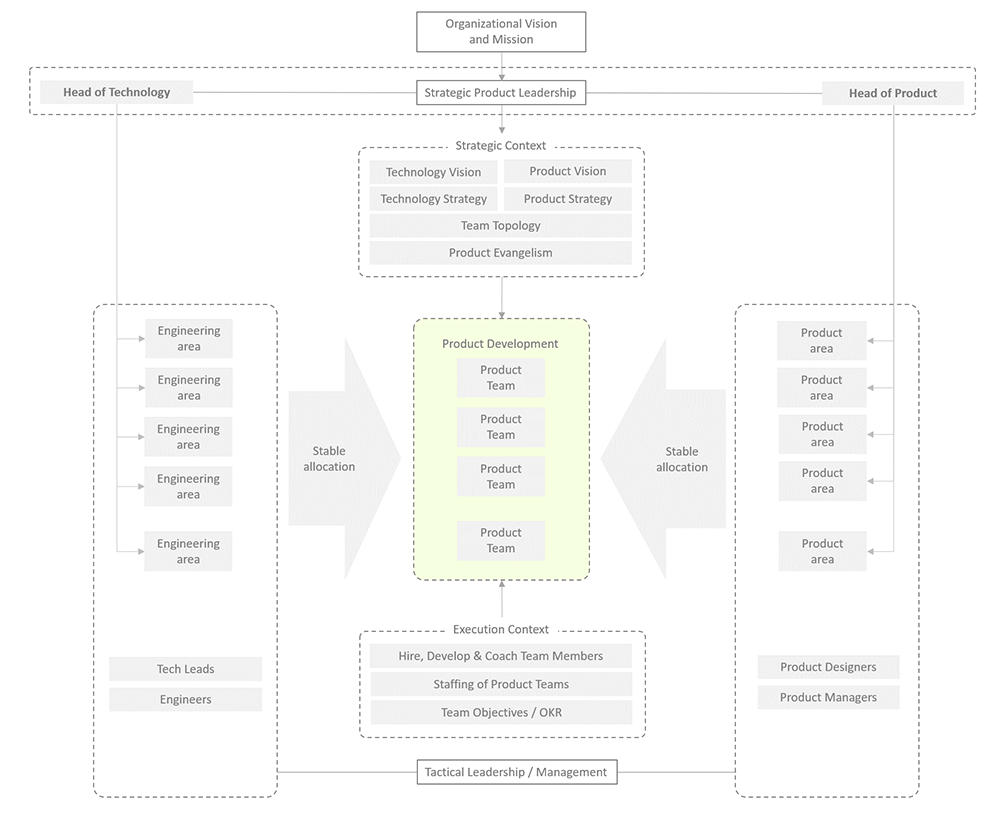
The assumption is here that you need more than “just” one project / product team to get to job done; in fact you’ve identified a need for a network of teams. The big question is now how to find an optimal design of each team and their relation in the network. “Optimal” is not a text-book thing. “Optimal” for you is what makes best sense in your context.
Given your unique context, the challenge is to find the optimal balance between process prescriptions (telling people how to do stuff) and trust (people will figure-out how to do stuff).

Here it is important to distinguish between bureaucracy and control. Bureaucracy, dressed as prescribed processes, is one of the means to maintain control. In the other end of the spectrum, you’ll find a Minimum Viable set of mandatory processes combined with a highly versatile Pick & Use toolbox.
We’ll here assume two mature and equally successful organizations with fundamentally different cultures and value-sets.
More and more organizations have come to realize the effect of the “auto-pilot”, now calling for a bureaucracy-detox cure.

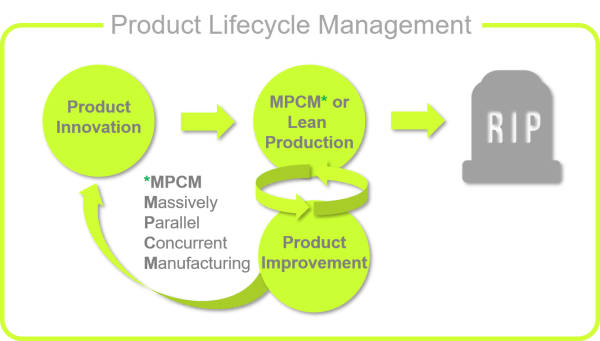
This is the top-level view of a Products Lifecycle. It gets
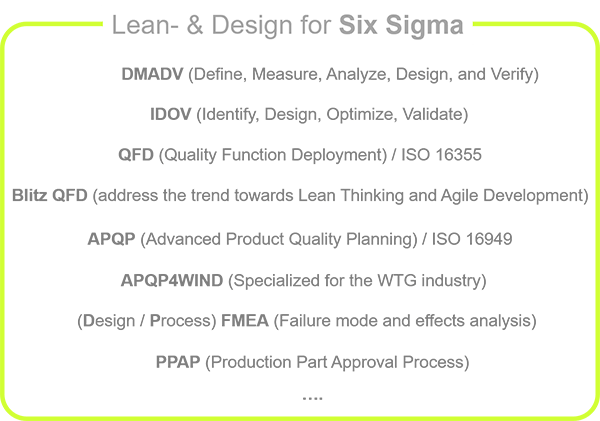
The need to deliver what the customers need, with the right quality and in a lean way is far from new. The various flavors of e.g., Six Sigma, dating back to the last millennium, exemplifies that.
Add to that the suite of other 
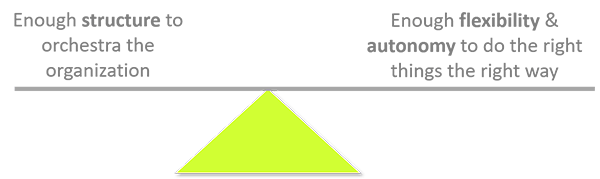
The typical spine-reaction to increased complexity in classically structured organizations is stricter Project governance, more control bodies, stricter and increasingly complex Project process prescriptions, more checklists, more reporting, more detailed planning – even for stuff that cannot be planned. Decisions are delayed, needing to travel up and down the hierarchies. The odd thing is that the biggest decisions are taken far away from where the biggest insight and information is. A bit sarcastically some describe this as “HIPPO” meaning the Highest Payed Persons Opinion.
Today, looking in the rearview mirror, the company has come to realize that such a Business Case included a lot of guess-work for the simple reason that the solution was not known at the time of writing the Business Case. The company has taken the consequence and changed the way it funds product development: today it uses a
Let’s define some assumptions, setting the context for this post:
Another classic error seen among less experienced project managers is the reactive activity planning-forward mindset. They’ll quickly loose sight of the real end-goal.
to inspire and challenge your travelers. Example:
In the “old days”, we would work with “horizontal slices” e.g., building the server-layer, then the middle-ware and finally the user-application layer. It would thus take a long time before the users could see anything.
Let’s assume the availability of a time-machine enabling us to jump to the point in time where we’ve reached the goal of achieving fast-paced innovation of our high-tech products.
With agreed stable contracts, Product Teams can work (fairly) autonomously thus achieving a high degree of parallelism rendering accelerated product development.
To keep focus we’ll here assume the context of a high-tech product company innovating, producing and selling its own multidisciplinary (electronics, hardware, mechanics, embedded software, application software, Cloud services …) products. The company has three core product process areas (A), (B) and (C).